
Introduction to Codex AI
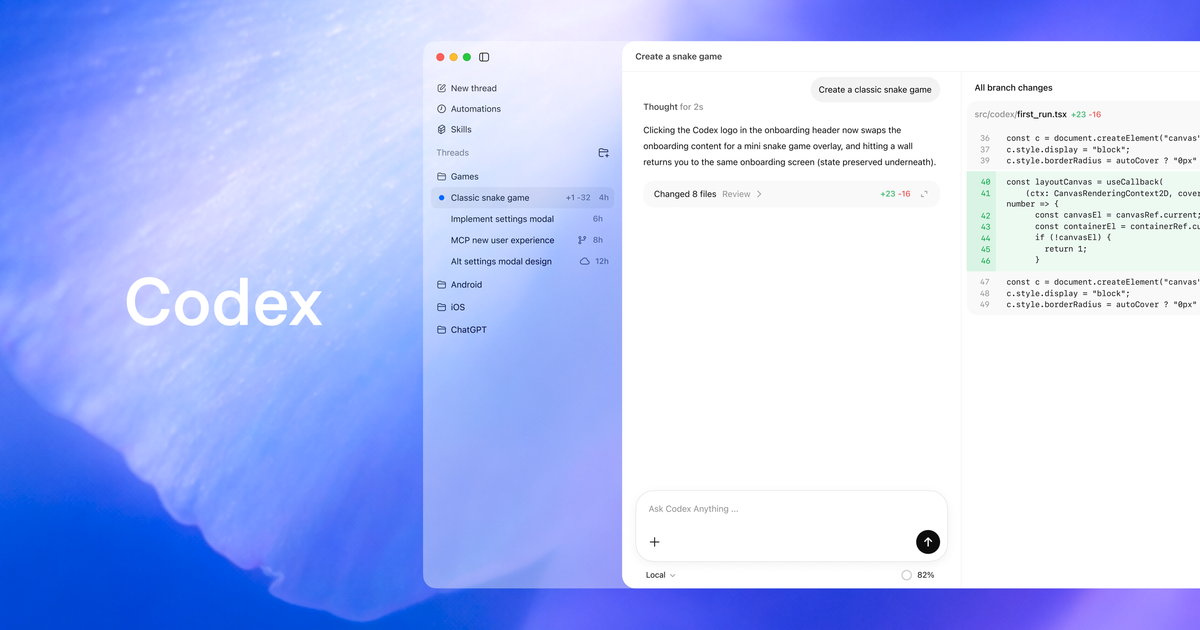
Codex is an advanced AI coding agent created by OpenAI. Unlike simple chatbots, Codex is designed to help developers build, debug, and ship software more efficiently. It functions as a “coding agent,” meaning it doesn’t just suggest text—it can interact with your file system and execute complex workflows to automate development tasks.
Table of Contents
What Exactly is Codex AI?
At its core, Codex is a lightweight coding agent that primarily runs in your terminal (CLI) or via a desktop app. According to OpenAI, it is designed to help builders ship products faster by handling the heavy lifting of coding.
Technically, Codex uses a “harness.” This is a system that wraps around the AI model, allowing it to access your files, make direct changes to code, and follow specific guardrails to ensure safety and accuracy. While it is built for code, its ability to follow instructions and navigate data makes it a potential gateway for general-purpose AI agents in business.
Key Features and Capabilities
Codex offers several powerful tools that set it apart from standard AI assistants:
- Terminal-Based Workflow: It operates as a CLI tool, allowing developers to stay in their coding environment without switching windows.
- Plugin Support: Users can install bundles of skills and app integrations to create reusable workflows. These can be installed locally or shared across a project team (OpenAI Developers).
- Skills: These are shareable, text-based instruction sets that steer how the agent behaves, making it easier to standardize tasks across a team.
- Advanced Sandboxing: To ensure security, Codex uses strong sandboxing to prevent the AI from making unauthorized or dangerous changes to a system.
- Realtime Streaming: Recent updates have introduced Realtime V2 background agent streaming for smoother interactions (Releasebot).
Understanding the Codex Models
OpenAI provides various models depending on the user’s needs and subscription level:
- GPT-5.3-Codex: A powerful model designed for practical coding and reasoning applications.
- GPT-5.4 & GPT-5.4-mini: The latest iterations available for various user tiers.
- GPT-5.3-Codex-Spark: An ultra-fast model available to ChatGPT Pro users. Powered by Cerebras WSE hardware, it can generate code at over 1,000 tokens per second for real-time conversational coding.
Pricing Plans: Which One is Right for You?
As of April 2026, OpenAI has introduced a tiered pricing structure to accommodate different levels of usage (Oflight Inc.):
| Plan | Monthly Cost | Key Features |
|---|---|---|
| Plus | Standard | Light personal use; basic Codex access. |
| Pro ($100) | $100 | 5x usage of Plus (10x during promotion), 128K context window. |
| Pro ($200) | $200 | 256K context window, access to GPT-5.3-Codex-Spark, top-priority processing. |
| Business | Token-based | Dedicated Codex seats and enterprise-grade scaling. |
Impact on Modern Development
Codex is seeing massive growth, with reports indicating over 3 million weekly active users (Financial Express). Companies are using it to drastically reduce iteration times—some reporting a 30-50% cut in early development phases.
Beyond just writing code, Codex is being used for:
- Automated Refactoring: Updating large codebases and generating tests quickly.
- Bug Detection: Catching tricky backward compatibility issues that human reviewers might miss.
- Non-Technical Automation: Using code to automate spreadsheets or financial models, bringing the power of coding to non-programmers (Fortune).
Frequently Asked Questions
Q: Is Codex AI only for professional programmers?
A: While it is a powerful tool for developers, OpenAI is designing it to be a gateway for non-technical workers to automate software tasks through safe, sandboxed environments.
Q: What is the difference between the $100 and $200 Pro plans?
A: The $200 plan offers a larger context window (256K vs 128K), allowing it to process larger codebases at once, and provides access to the ultra-fast GPT-5.3-Codex-Spark model.
Q: How does Codex differ from a standard AI chatbot?
A: Codex is an “agent.” It can access your file system, use a terminal, and execute workflows, whereas a chatbot generally only provides text responses.
Q: Can I use Codex for free?
A: Codex is integrated into various OpenAI tiers. While there are paid Pro plans for heavy use, different access levels exist depending on your ChatGPT subscription.
Sources
- Changelog – Codex | OpenAI Developers – developers.openai.com
- Latest Codex News and Updates — What’s New About AI? – whatsnewaboutai.com
- Releases · openai/codex – github.com
- Codex by OpenAI – Release Notes – April 2026 Latest Updates – Releasebot – releasebot.io
- OpenAI reports Codex usage is surging, says it plans to make Codex heart of wider agent push | Fortune – fortune.com
- Sam Altman resets OpenAI Codex limits after Anthropic’s alarming Claude Mythos update – Technology News | The Financial Express – financialexpress.com
- OpenAI Codex Pro Plan Deep Dive — New $100 Tier vs $200 Pro Compared [April 2026 Update] | Oflight Inc. – oflight.co.jp
- Codex | AI Coding Agent – chatgpt.com